
On this page
- Decide what you'll offer, and where
- Check the rules where you live
- Get insured before the first clean
- Build a starter kit
- Set your first prices
- Work out what your goal takes
- Prepare your paperwork before the first client
- Find your first clients
- Keep records from day one
- Frequently asked questions
- Going further
Decide what you'll offer, and where
Start with a short menu you can price and explain in one sentence per service.
Standard recurring cleans
Weekly, every two weeks or monthly. This is the steady income most solo cleaners build on.
Deep and move-out cleans
One-off jobs that pay more but take longer. Our deep clean checklist shows what they add.
Vacation rental turnovers
Scheduled resets between guests.
Small offices and shops
Commercial cleaning is usually bid as a monthly price from square footage and cleaning speeds, not by the hour. The Commercial Cleaning Bid Calculator & Proposal does that math and flags a bid that falls below your margin.
Service area
Neighborhoods you can reach quickly. Driving time is unpaid unless your price covers it.
Check the rules where you live
Rules vary by country, state or province, and city, so treat these as questions to check, not answers.
- Business registration. In many places you can start as a sole proprietor under your own name. A business name often has to be registered (in the US, usually a DBA). An LLC isn't required to start.
- Business license. Many cities and counties require one, and some a home-occupation permit. Check your city or county website.
- Taxes in the US. Self-employment tax generally applies once your net self-employment earnings reach $400 for the year, and you may owe estimated tax quarterly.
- Taxes in Canada. You generally have to register for GST/HST once taxable revenue goes over $30,000 in one calendar quarter or over the last four consecutive quarters.
- Hiring help. Whether a helper is an employee or a contractor is decided by local rules, not by the label. Employees usually bring payroll and workers' compensation obligations.
Get insured before the first clean
General liability insurance is the policy clients ask about most. It's meant for injuries to other people and accidental damage, such as a client tripping over your vacuum cord.
When you compare quotes, ask: does the policy exclude property in your "care, custody or control", such as items you move or clean? Does it cover lost keys? Get the answers in writing.
General liability insurance
- Injuries to other people, such as a client tripping over your cord
- Accidental damage
- Ask: does it exclude property in your care, custody or control?
- Ask: does it cover lost keys?
Janitorial bond
- Theft by you or your staff, up to the bond limit
- Not accidents or injuries
- With some bonds you repay the bonding company after a claim
- Ask how claims work
Build a starter kit
Keep it small; bulk buying can wait until you know which products you actually use.
Cleaners
All-purpose, glass, bathroom (soap scum and hard water), a kitchen degreaser and a floor cleaner.
Tools
Color-coded microfiber cloths (one color for bathrooms only), scrub and grout brushes, a mop and bucket, an extendable duster and a caddy.
Vacuum
One that handles pet hair and stairs. You'll use it more than anything else.
Protection
Gloves, and the safety data sheets for the products you carry.
Set your first prices
Don't copy the cheapest price nearby. Your price has to pay for the drive and supplies as well as the time inside:
For example, at $45 an hour, a home that takes 2.5 hours on site with 30 minutes of round-trip travel and $6 of supplies comes to 3 × $45 + $6 = $141. Rounded, that's $145. Our guide to how much to charge for house cleaning has typical rates and the real $/hour check.
- 3 hours (2.5 on site + 0.5 travel) × $45$135
- Supplies$6
Price, rounded up from $141$145
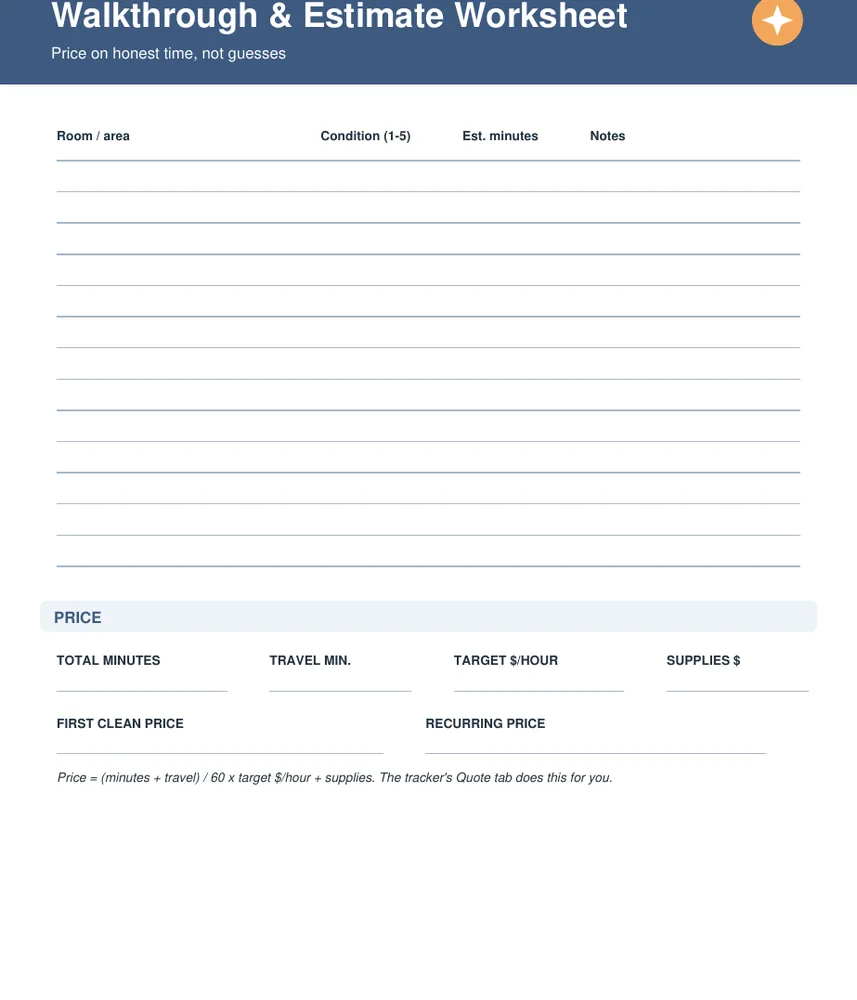
Quote first cleans separately, because they take longer, and set a minimum charge so small jobs cover the drive. The walkthrough guide turns a home tour into minutes.
Work out what your goal takes
Now check the other direction: how many cleans a month does your income goal need at that price?
Example figures only: say you want $3,000 a month to live on, set aside $900 for tax, and have $300 of monthly costs such as insurance, supplies and fuel. That's $4,200.
At $145 a clean it takes 29 cleans (29 × $145 = $4,205). At 3 hours each including travel, that's 87 hours a month, about 20 hours a week.
- Take-home goal$3,000
- Tax set-aside$900
- Monthly costs$300
Needed each month$4,200
÷ $145 a clean = 29 cleans (29 × $145 = $4,205). × 3 hours = 87 hours a month, about 20 hours a week.
If your own numbers come out at 60 hours a week, the price or the service area is the problem, not your effort.
Prepare your paperwork before the first client
Clear paperwork prevents the usual disputes: what "clean" meant, who pays for a lockout, what a late cancellation costs.
- Service terms. What each clean includes and excludes, arrival window, cancellation and lockout fees, breakage, re-cleans and payment. Have them checked for where you work.
- Client intake. Contact details, access, alarm codes, pets, parking and product sensitivities.
- Walkthrough estimate. Room-by-room minutes and the quote, so every home is priced the same way.
- A checklist for each type of clean. Standard, deep and move-out, so clients see what the price covers.
- Key and access log. Which keys and codes you hold, and when they were returned.
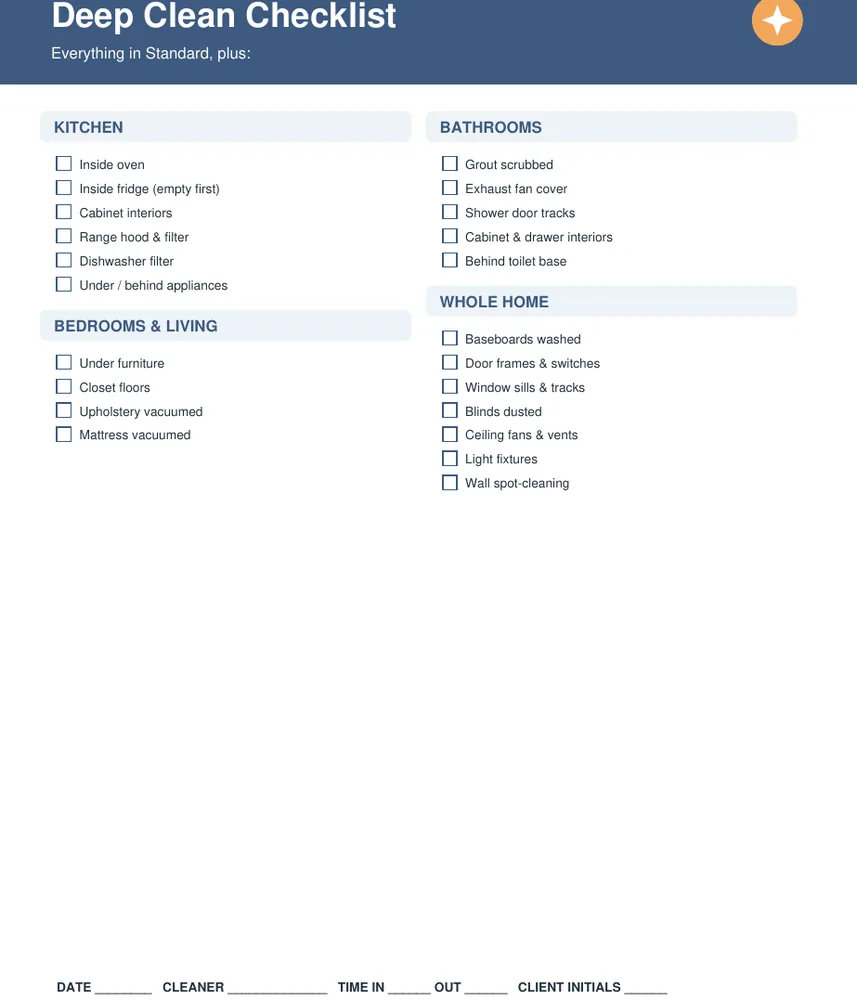
Free room-by-room cleaning checklists
Standard, deep clean and move-in/move-out checklists with a client sign-off line, ready for your first booking.
Get it free on Gumroad Enter $0 at checkout.The Cleaning Business Client Forms Pack puts the intake form, walkthrough estimate worksheet, service terms, quality inspection report and key log on five printable pages.
Find your first clients
Tell everyone you know.
Friends and neighbors are often the first bookings, and their reviews win the next ones.
Set up a Google Business Profile.
A home-based business can list as a service-area business and hide its street address. Ask happy clients for reviews.
Post in local groups.
Try neighborhood apps and community Facebook groups, following each group's rules on business posts.
Leave door hangers near homes you already clean.
In the US, don't put flyers in mailboxes; they're for postage-paid mail only.
Meet people with deadlines.
Real estate agents and property managers need move-out cleans; vacation rental hosts need turnovers.
Ask for referrals.
A small credit for each new recurring home a client sends you rewards the people already promoting you.
Note where every inquiry came from. After a month you'll know which channels are worth your time.
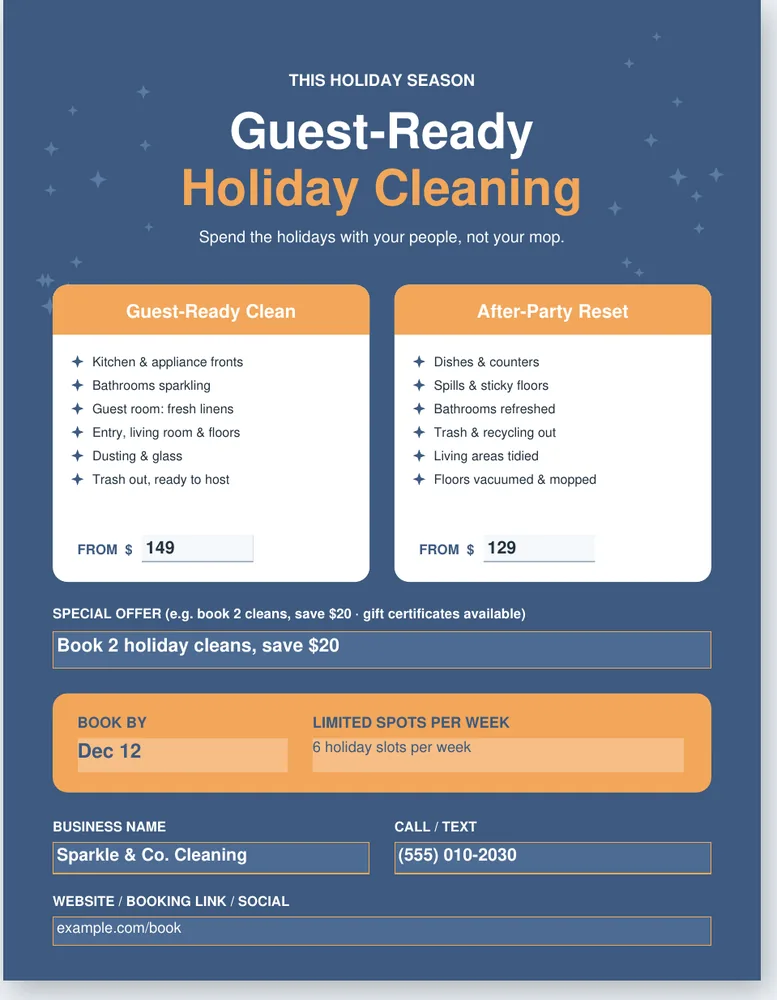
Starting in the fall? The Cleaning Business Holiday Promo Kit has a fillable price list, holiday flyer and gift certificates for guest-ready cleans. For hosts, the Vacation Rental Turnover Cleaning Kit adds a rate sheet, turnover checklist and damage report.
Keep records from day one
Open a separate bank account, and log every job, payment, expense and business mile from the first clean. It takes minutes a day and makes tax time far easier.
- Every job
- Every payment
- Every expense
- Every business mile
Once you have a few recurring clients, work out each home's real dollars per hour, including travel. Two homes at the same price can pay very differently.
Frequently asked questions
Do I need a license to start a house cleaning business?
It depends on where you live. Many cities and counties require a general business license, and some a home-occupation permit. Check your city or county website, or call their licensing office.
Do I need insurance to clean houses?
It isn't always legally required, but clients and property managers often ask for proof of general liability insurance. Ask whether a policy covers property in your care, custody or control, and lost keys. A janitorial bond is separate and relates to theft.
How many clients do I need to make a living?
Work it out from your own numbers: take-home goal, plus tax set-aside and monthly costs, divided by your price per clean. In this guide's example, $4,200 a month at $145 a clean takes 29 cleans, about 20 hours a week including travel.
Should I charge by the hour or a flat rate when starting out?
Many cleaners charge hourly or a padded estimate for the first clean, then switch to a flat rate for recurring visits once they've timed the home two or three times. Either way, include travel in the price and set a minimum charge.
Going further
The Cleaning Business Tracker (Excel + Google Sheets) does this guide's pricing math: real $/hour for every home including travel, a quote calculator, a job log that flags unpaid jobs, and a profit dashboard with a tax set-aside. In Canada? The Cleaning + Canada Tracker Bundle adds an income, expense and GST/HST tracker.
Disclosure: the templates linked here are made and sold by this site's shop. This is general information, not legal, tax or insurance advice; rules vary by location. Follow product labels and safety data sheets.