
On this page
- Decide what you'll bake, and how you'll sell it
- Check the rules where you live
- Get insured and food-safe
- Set up your kitchen and starter kit
- Price from true cost, not from the cheapest baker nearby
- Work out what your goal takes
- Prepare your order paperwork
- Find your first customers
- Keep records from day one
- Frequently asked questions
- Going further
Decide what you'll bake, and how you'll sell it
Start with a short menu you can bake well and price with confidence.
Custom cakes
The most per order, but they take a consultation, design time and a fixed pickup.
Cookies and bars by the dozen
Easier to batch, and they fill the weeks between cake orders.
Breads and seasonal boxes
Pre-orders with an order-by date, so you bake exactly what's sold.
How customers get it
Pickup, delivery or a market stall. Each has its own rules and costs.
Check the rules where you live
Home food rules vary by state, province and city, and they change often. Treat these as questions to check.
- Cottage food rules. Every US state allows some home-kitchen sales of lower-risk foods, with limits on foods, sales, where you sell and the label. Our cottage food law basics guide lists the six questions to answer.
- Canada. Home-based food businesses are regulated by each province or territory, often through your local public health unit. Contact them before your first sale.
- Your recipes. Cream cheese frosting, custards and anything that needs refrigeration are often excluded or have extra conditions.
- Local permits. Your city or county may require a business license or home-occupation permit.
- Taxes in the US. Self-employment tax generally applies once your net self-employment earnings reach $400 for the year. Whether baked goods are subject to sales tax depends on your state.
- Taxes in Canada. GST/HST registration is generally required once taxable revenue goes over $30,000 in one calendar quarter or the last four consecutive quarters. Some bakery items, such as single servings, can be taxable.
Get insured and food-safe
Product liability insurance covers claims that something you sold made someone ill or hurt them. Many markets and events ask vendors for proof of insurance.
Don't assume your home policy covers the business. Homeowner's and renter's policies often exclude business activity, so get your insurer's answer in writing.
- Product liabilityDoes it cover claims that something I sold made someone ill or hurt them?
- Your home policyDoes my homeowner's or renter's policy exclude or limit business activity?
- Markets and eventsCan I get the proof of insurance a market or event asks for?
A food handler course is required by some cottage food programs and is worth doing either way.
Set up your kitchen and starter kit
Buy what your menu needs. The basics:
A digital scale
Weighing in grams keeps batches consistent and lets you cost recipes to the gram.
An oven thermometer
Home ovens often run hotter or cooler than the dial says.
Pans in your menu sizes
Plus cooling racks, a turntable and piping tips.
Packaging
Boards, boxes, bags and labels. Count them into your price.
Separate storage
A shelf for business ingredients. Keep pets out of the kitchen while you bake.
Price from true cost, not from the cheapest baker nearby
Your price has to pay for your time, not just the butter:
In our custom cake pricing guide, an 8-inch two-layer cake has a true cost of $71.41, including $50 for 2.5 hours of your time at $20 an hour. With a 30% margin it prices at $103. The same method gives $28 a dozen for chocolate chip cookies in our cookie pricing guide.
- Ingredients: cake + buttercream$14.96
- Packaging: box + board$4.50
- Overhead, 10%$1.95
- Your pay: 2.5 hours at $20$50.00
True cost$71.41
÷ (1 − 0.30) = $102.01, rounded up to $103.
Take a deposit before you block a date or buy ingredients, and set a minimum order.
Work out what your goal takes
Now check the other direction: how many orders a month does your goal need?
Example figures only: say you want $1,200 a month for your time and profit, before tax. Each $103 cake leaves $81.59 after ingredients, packaging and overhead ($103 − $21.41).
That takes 15 cakes a month (15 × $81.59 = $1,223.85). At 2.5 hours each, that's 37.5 hours of baking and decorating, about 9 hours a week, before shopping, messages and pickups.
- Cake price$103
- Ingredients, packaging, overhead$21.41
Left per cake$81.59
$1,200 ÷ $81.59 = 14.7, so 15 cakes (15 × $81.59 = $1,223.85). × 2.5 hours = 37.5 hours a month, about 9 a week.
Fifteen cakes is $1,545 a month in sales, or $18,540 a year. If your state caps cottage food sales, check your plan against the cap before you grow.
Prepare your order paperwork
Many disputes start with an order that only lived in a text thread: the wrong flavor, a missed allergy, a cancelled cake you'd already baked.
- Order form. Servings, flavors, design, dietary needs, pickup time, deposit and balance.
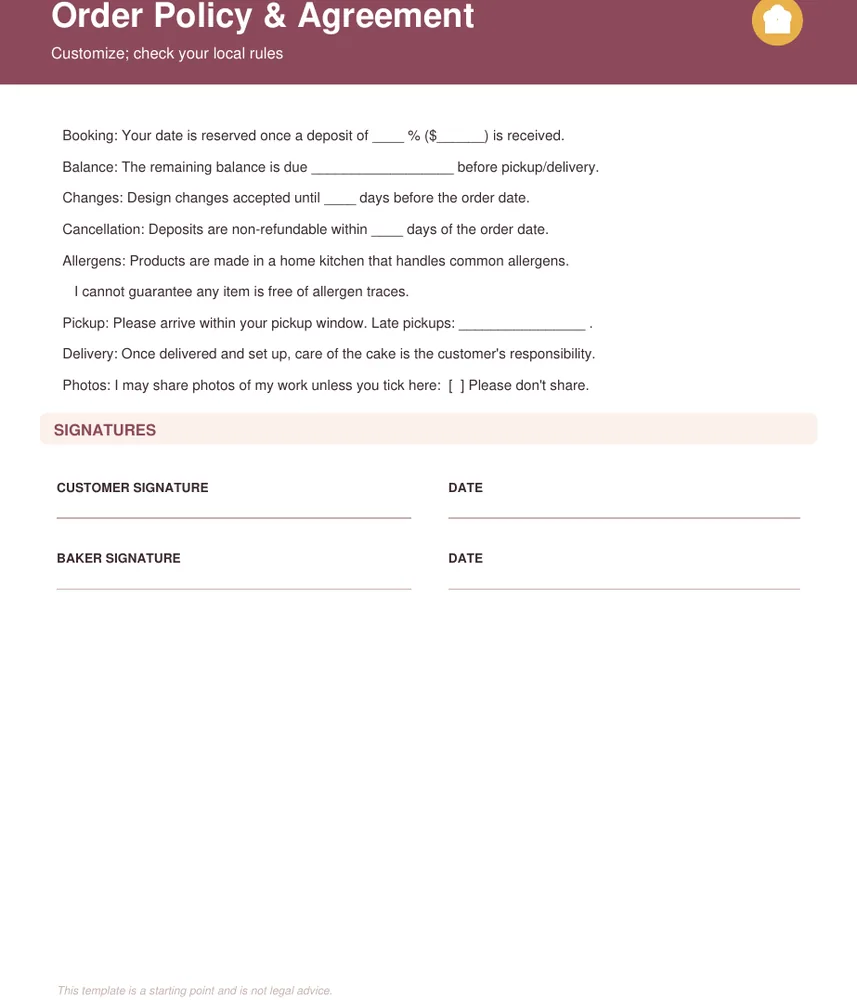
- Order policy. Deposit, changes, cancellation, allergen notice and pickup terms, shown before customers pay.
- Menu and price list. Sizes, servings and starting prices.
- Labels. The wording your rules require, copied exactly.
- Pickup log. Who collected what, when, and whether the balance was paid.
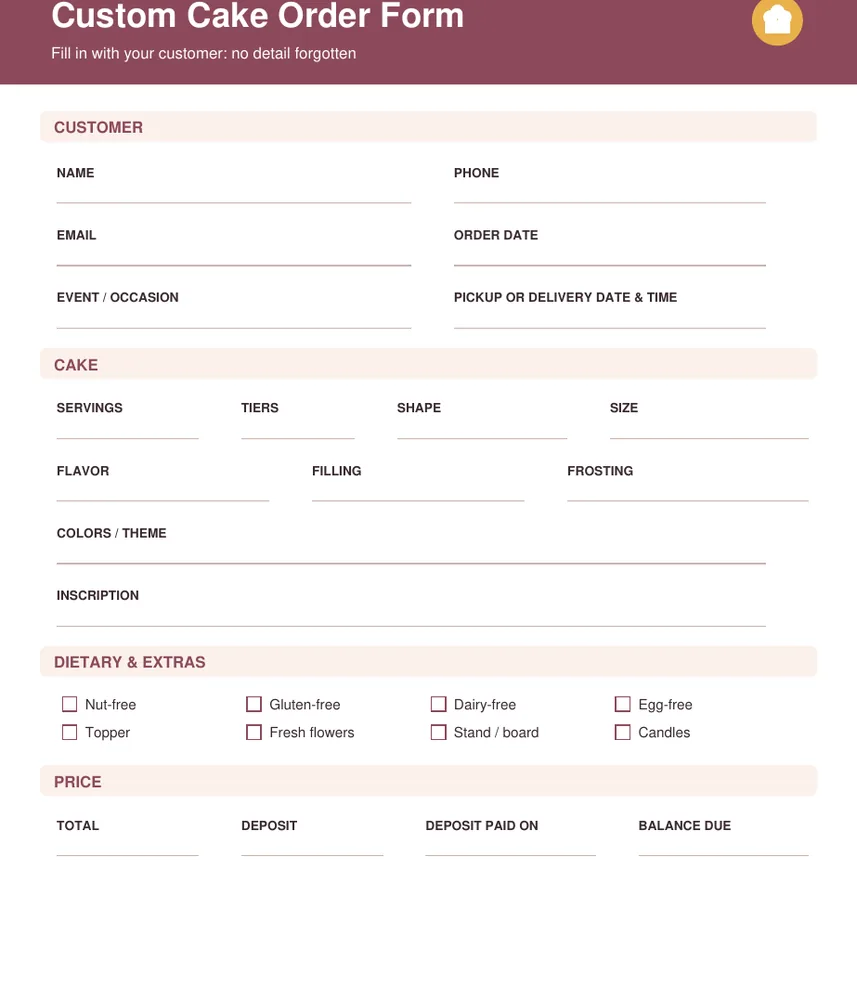
Free custom cake & treat order forms
Cake and cookie/treat order forms with allergen tick-boxes, deposit and balance, plus pickup slips, ready for your first order.
Get it free on Gumroad Enter $0 at checkout.The Home Bakery Business Forms pack adds an order policy and agreement, a production planner, a pickup log, an inventory list and consultation notes. For customers, the Cake Menu, Price List & Serving Guide is a fillable price list by cake size with servings, a flavor menu and a custom cake quote.
Find your first customers
Start with people you know.
Friends and coworkers are often the first orders, and their reviews win the next ones.
Photograph every bake.
Daylight and a plain background beat a fancy setup.
Set up a Google Business Profile.
Home-based businesses can usually hide their street address. Ask happy customers for reviews.
Post in local groups.
Follow each group's rules on business posts.
Try a market stall.
Check the market's rules and your cottage food rules first.
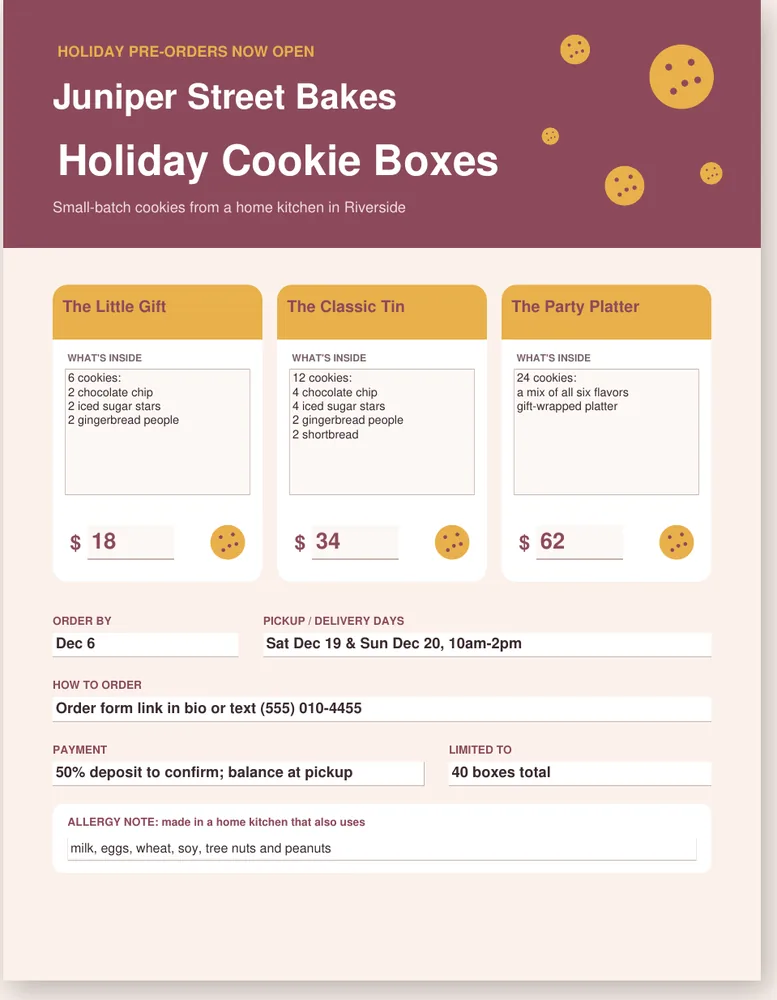
Run seasonal pre-orders.
A holiday box with an order-by date and set pickup days means no guessing quantities.
Selling to cafés and shops (wholesale) is often not allowed under cottage food rules, or needs a different license.
Planning holiday boxes? The Holiday Cookie Box Pre-Order Kit has a box menu, pre-order form, a production planner that turns boxes sold into batches, and allergen labels.
Keep records from day one
Open a separate bank account, and log every order, deposit, receipt and delivery mile from the first sale.
Keep a simple batch record too: what you baked, when, and who bought it. If a customer ever has a complaint, you'll know which batch it was.
- Every order and deposit
- Every ingredient receipt
- Every delivery mile
- Every batch, and who bought it
Frequently asked questions
Do I need a license to sell baked goods from home?
It depends on where you live. In the US, cottage food rules are set by each state: some need nothing for direct sales, others require registration, a fee, a course or an inspection.
Your city may also require a business license. In Canada, ask your provincial or local public health authority.
What baked goods can I sell from a home kitchen?
Usually lower-risk, shelf-stable foods such as cookies, breads, many cakes and fruit pies. Foods that need refrigeration, such as cheesecake or cream cheese frosting, are often excluded. Check your state's current list.
Do I need insurance for a home bakery?
It isn't always required, but product liability insurance covers claims that something you sold made someone ill, and many markets ask for proof of it. Ask whether your home policy excludes business activity.
How much should I charge as a new home baker?
Price from true cost: ingredients, packaging, overhead and your pay, then a margin. In this guide's example, a cake with a $71.41 true cost prices at $103 with a 30% margin.
Should I take deposits on custom orders?
Yes. Take one before you block the date or buy ingredients, and put your deposit and cancellation terms in writing before customers pay.
Going further
The Home Bakery Pricing & Order Tracker (Excel + Google Sheets) does this guide's math: ingredient cost per gram, a true cost for each product including your pay and overhead, a suggested price, and orders with deposits and balances. In Canada? The Home Bakery + Canada Tracker Bundle adds an income, expense and GST/HST tracker.
Disclosure: the templates linked here are made and sold by this site's shop. This is general information, not legal, tax, insurance or food-safety advice. Cottage food and home food rules vary by state, province and city, so check yours.